Guide
Insider threat: definition, profiles, indicators
This guide starts from the two reference texts on insider threat, from CISA and from Carnegie Mellon's CERT, and applies them to a small or mid-sized business. Several of the published cases come from French agencies and courts. It is written by the team at SSHack, an offensive security firm and the publisher of VigiDoc, a DLP (data loss prevention) tool.
In brief
Insider threat is the risk that someone with legitimate access harms the organization, intentionally or not; CISA and CERT both include honest mistakes. Four profiles keep coming back: the careless employee who makes a mistake, the employee who works around a rule for convenience, the malicious insider who takes files, and the compromised user whose account is used by an attacker. In France, organizations that report a breach to the CNIL, the national data protection authority, declare an accidental internal act about four times more often than a malicious one. The high-risk moments (notice period, end of contract, end of a contractor's assignment, reorganization) are known in advance, which makes the risk manageable for a small business.
The definition, and what it includes
The first reference text is the Insider Threat Mitigation Guide published by CISA, the US Cybersecurity and Infrastructure Security Agency, in November 2020. It defines insider threat as the potential for an insider to use their authorized access or special understanding of an organization to harm it; the harm can come from malicious, complacent or unintentional acts (page 10). Former employees and contractors are included.
The second is the Common Sense Guide to Mitigating Insider Threats from Carnegie Mellon's CERT, seventh edition, September 2022, drawn from more than 3,000 adjudicated cases. It covers the use of authorized access, "maliciously or unintentionally", in ways that could harm the organization. CERT separates insider threat (the potential) from insider risk (its likelihood and impact).
Intent is therefore not the test. The assistant who sends payroll to the wrong recipient and the manager who copies a program before leaving fall into the same category, even though they call for different responses. The test is legitimate access: the person has nothing to break into, so tools built against intrusion see very little.
Four profiles, with the numbers
CISA separates unintentional acts (accidents and negligence) from intentional ones, and adds collusion with an outside actor and third parties. Proofpoint and DTEX also count the compromised account. We use four profiles, with the figures sourced in our page Insider data leaks: the 2026 numbers (in French).
47%
of French CISOs affected by data loss blame careless employees; 39% malicious insiders; 31% compromised users (multiple answers allowed).
Proofpoint, Voice of the CISO 2026 · 36 affected CISOs out of 100 surveyed, organizations with 1,000+ employees
13.8 of 25.4
annual insider incidents per organization come from negligence; 6.3 from a malicious insider; 5.3 from credential theft.
DTEX and Ponemon Institute, Cost of Insider Risks 2026 · 354 organizations, 2025 data
4% to 6%
of breaches reported to the CNIL (France's data protection authority) are declared as a malicious internal act, versus about 20% for an accidental internal act.
SSHack calculation on CNIL open data · 24,530 notifications, 2019 to 2024
12%
of breaches analyzed worldwide involve an internal actor; 20% in Europe, the Middle East and Africa.
Verizon, DBIR 2026 · more than 22,000 breaches, November 2024 to October 2025
1. The careless employee
They make a mistake without knowing it: an attachment sent to the wrong recipient, a lost USB drive, a malicious link opened. This is CISA's "accident", illustrated by a sensitive email sent to a competitor after a typo in the address. It is the most frequent profile in the studies cited above (13.8 incidents out of 25.4 at DTEX and Ponemon). In France, 13% of the 6,167 breaches reported to the CNIL in 2025 came from a message sent to the wrong recipient. The response is to correct quickly and adjust the tools.
2. The convenience employee
They know the rule and work around it to get the job done: a folder sent to a personal mailbox, a personal USB drive, a consumer file transfer service, a free generative AI tool. CISA files this under negligence and describes someone who knows the security policies but chooses to ignore them. Verizon measures this motive: among employees who deliberately misuse their access, 60% do it for convenience (DBIR 2026). When ten employees email files to their personal accounts, it first means a sharing tool is missing.
3. The malicious insider
They take, sell or destroy. CERT identifies termination and resignation as the leading stressors, and leaving for a competitor as the leading concerning behavior. Malicious insiders are a minority and go unnoticed for a long time: the DGSI, France's domestic intelligence agency, notes that such thefts "are often discovered late" (our translation).
4. The compromised user
Their account or computer is used by an outside attacker after phishing or a stolen password. Strictly speaking, the actor is external; Proofpoint (31%) and DTEX (5.3 incidents) include it because, in the logs, everything starts from a legitimate account. The same logs help tell the employee apart from the attacker, for example when files go out while the employee is on vacation.
Documented insider threat indicators
Both guides stress the same point: a single indicator does not identify anyone. It tells you when to look at the logs more closely, within the framework announced to employees.
Human indicators. CISA lists workplace stressors: demotion or missed promotion, loss of status in a merger, conflict with coworkers, poor performance review, end of contract, termination (page 64). Its behavioral indicators include talk of resigning, open resentment and unauthorized contact with competitors (page 66). In the CERT database (1,314 incidents), termination (375 incidents) and resignation (245) are the two most frequent stressors, and leaving for a competitor is the most frequent concerning behavior (89).
Technical indicators. CISA cites an unknown device connected to a computer (USB drive, external disk), emails with unusually large attachments and the copying of large numbers of documents. It adds access to resources unrelated to the role, activity outside normal hours, sensitive access kept after a departure is announced, and keyword hits in emails (page 67). CERT points to the employee who downloads sensitive data "within 30 days" before resigning (page 66).
In a small business, two signals are often enough: a change in volume (one week of copies equal to six months) and a change in scope (files unrelated to the person's job). Both show up in a log of outgoing data, provided you keep one.
High-risk moments
The sources agree on four moments, all known to the company in advance.
- The notice period. CERT describes a process where HR tells the security team about a resignation; the team then reviews the employee's activity, especially the logs for the 30 days before and after (page 26). CERT also notes that malicious insiders often act within 90 days of their departure (page 84). Verizon recommends an activity review as soon as someone with access to sensitive data resigns or is terminated. Our offboarding security checklist for the last 30 days walks through that review.
- The end of a contract. According to the DGSI, these thefts "are often committed by staff working within the victim companies, in particular employees at the end of their contract, interns or even service providers" (our translation).
- The end of a contractor's assignment. CISA counts third parties among insider threats. A contractor often has broad access and nobody in charge of their departure.
- Reorganization. CISA lists loss of status in a merger among stressors, and a recent merger among organizational indicators (page 68). CERT reports the case of a bank where employees, unhappy about layoffs, copied the customer database before resigning en masse (page 46).
A small business therefore does not need to watch everyone all the time. It looks more closely at one identified account, for a limited period, using logs that already existed.
Published cases
The first three cases were published by French agencies and courts. The DGSI is France's domestic intelligence agency, the DRSD is the French defense intelligence and security directorate (in charge of protecting the defense industry), and the DGSE is France's foreign intelligence service. The fourth case comes from the US federal courts. Quotations from French sources are our translations.
DGSI, economic interference bulletin no. 106 (Flash ingérence économique), October 2024
Three cases. A manager in charge of a sensitive program, with fifteen years of seniority, copies several tens of thousands of files to an external disk shortly before leaving; "IT monitoring put in place by the company during the employee's notice period made it possible to detect the data theft". An engineer downloads several thousand documents from his company's cloud; he is arrested, then placed under judicial supervision. An engineer from a contractor, on site at a manufacturer for more than a year, copies more than 5,000 files to a USB drive, 300 of them unrelated to his assignment; he receives a prison sentence.
DRSD, 2025 review of interference against the defense sector, May 2026
A former technical director of an aerospace defense company announces on LinkedIn that he is open to opportunities. A foreign consulting firm offers him an interview paid "several hundred euros an hour" and questions him about his former programs; he cuts the conversation short and alerts the DRSD. The same bulletin points to "the negligence of some employees who are not always aware that they have access to part of the company's intangible assets".
Paris criminal court, February 23, 2026: the former DGSE engineer
In 2024 he downloaded many classified files, some of them unrelated to his field, before joining a German start-up. He received an eighteen-month suspended prison sentence and a €4,000 fine for removing and copying protected documents, and acquitted of handing them to a foreign company for lack of proof of transmission. The copying was proven; the handover was not.
US federal court, 2025: Chenguang Gong
An engineer at a California defense contractor, he transferred more than 3,600 files to three personal storage devices between March 30 and April 26, 2023, the day he was fired, more than 1,800 of them after accepting a job with a competitor. The files were marked "PROPRIETARY" and "EXPORT CONTROLLED". He pleaded guilty in July 2025 and was sentenced to 46 months in prison in November 2025.
In November 2024, Jack Teixeira, 22, an IT technician in the US Air National Guard with a top secret clearance, was sentenced to fifteen years in prison for retaining and sharing classified information with a group of gamers on Discord. That case is about need-to-know more than about an endpoint tool. In the DGSI, DGSE and Chenguang Gong cases, the established facts are file copies or downloads; our first-48-hours protocol (in French) explains how to preserve that evidence.
An insider risk program for a small business
CERT and CISA describe programs designed for large organizations. A small business with 50 to 300 computers can cover the essentials with the people already in place (owner or executive, HR, IT), in six elements.
- Inform. Employees know that outgoing data is logged, why, and who reviews it. Without that notice, the logs cannot be used.
- Write the acceptable use policy. It states what is provided (a sharing tool, company USB drives) and what is not allowed (personal email for work documents, consumer AI tools with customer data). It is handed to employees when they are hired and restated when they leave.
- Manage access. The DGSI advises companies to "tier IT access within the company according to the profile and duties of employees" (our translation). In a small business, this starts with moving pricing, R&D, payroll and contracts out of the single shared drive.
- Review every departure. HR flags the departure the day it is announced, outgoing data for the account is reviewed weekly during the notice period, all access is cut on the last day, shared account passwords are changed, and remaining access is reviewed at D+7 and D+30. The end of a fixed-term contract, an internship or a contractor's assignment follows the same process.
- Detect on the endpoints. Windows and Microsoft 365 tell you which USB drive was plugged in and which email went out, not which files were copied or what the attachment contained. A detection-only DLP fills that gap without interrupting work; the choice between detecting and blocking is covered in Block or monitor USB drives?.
- Prepare the 48-hour procedure. When a suspicious email or an unknown USB drive shows up: do not confront the person, do not touch the computer, preserve the logs, rebuild the timeline, hand over to a lawyer. The DGSI points out that filing a criminal complaint is the route to criminal penalties in France.
CERT adds a 22nd best practice: learn from past incidents. In a small business, one page per incident is enough (what went out, through which channel, what changed), and it usually ends with a setting change or a tool being provided. For alerts, our DLP keywords by sector are ready to test.
The minimum legal framework
The rules below are the French example; applying them to a specific case is a lawyer's job. Outside France, check your local employment and privacy law (GDPR in the EU).
- Prior notice. French labor law (article L1222-4 of the Labor Code) states that no personal information about an employee may be collected by a system that was not disclosed to the employee beforehand. The list of alert keywords itself does not have to be published.
- Proportionality. The CNIL requires monitoring to be justified and proportionate to its purpose; messages and files identified as personal follow specific rules.
- Works council. From 50 employees, the works council (CSE) must be informed and consulted before any system that monitors employee activity is put in place.
For a contractor, the basis is the contract and the policy attached to it. On evidence, France's highest court (Cour de cassation) accepted in 2024 files taken from personal USB drives because producing them was essential and proportionate (labor chamber, September 25, 2024, no. 23-13.992); each case is assessed on its own facts.
Seen by an offensive security team
In an internal penetration test, SSHack plays the insider. The shortest path to get a file out goes through a legitimate account, an overly broad share, then the least monitored channel: USB drive, personal webmail in the browser, printing. We first look for what is missing: no log of copies to removable media, no review of external emails, contractor accounts never closed. A visible block tells us something and pushes us to another channel; quiet detection keeps us on the monitored path. That is the basis of our position, detect rather than block. The most credible profile to imitate is still convenience, because nobody is surprised by an employee who emails a file to work from home.
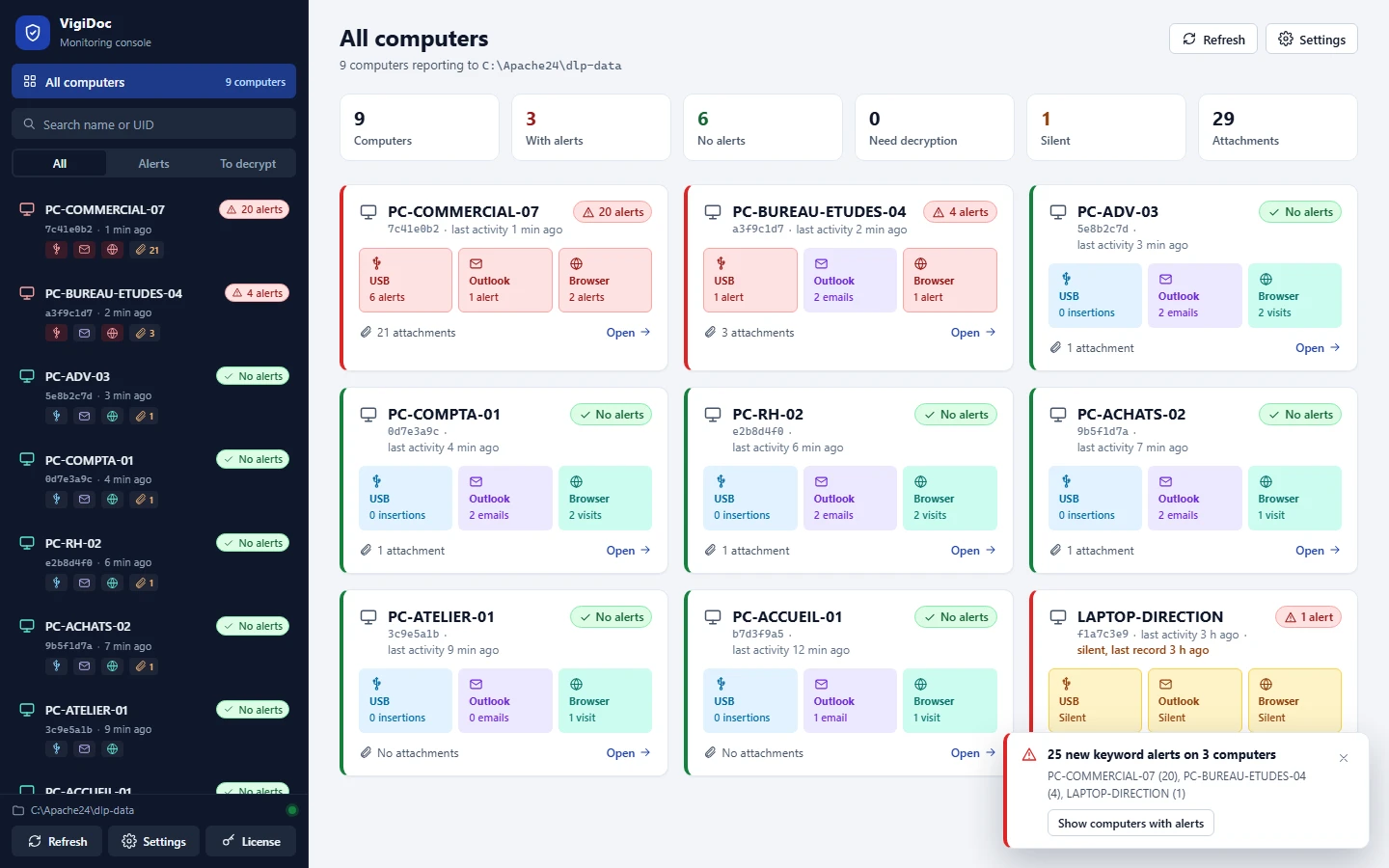
What VigiDoc sees, and what it does not
VigiDoc, SSHack's DLP software for Windows endpoints, covers the fifth element of the program. It logs every file copied to a USB drive or external disk and keeps an encrypted copy, records emails sent from Outlook with their attachments and the attachments added in Gmail and Outlook on the web, and collects Chrome, Edge and Firefox history. An alert appears when a keyword chosen by the company shows up in a copied file, a subject line, an attachment or a visited page. It detects and alerts without blocking anything: the employee works normally, and all four profiles leave the same trail.
Its blind spots are known: printing, screenshots, a phone connected in file transfer mode, text pasted into webmail or an AI tool (only the page visit is logged) and the contents of password-protected archives. It does not look back in time, apart from the last 7 days of Outlook email: install it before the next departure, within the framework announced to employees. The 30-day trial starts when the server is installed, with no license to request.
Frequently asked questions
What is an insider threat?
It is the risk that a person with legitimate access (employee, former employee, intern, contractor) uses that access or their knowledge of the organization to harm it, intentionally or not. The definitions from CISA (2020) and from Carnegie Mellon's CERT (7th edition, 2022) cover both malicious and unintentional acts.
Does a mistake or negligence count as an insider threat?
Yes. CISA splits insider threats into unintentional (accident, negligence) and intentional, and gives as an example of an accident a sensitive email sent by mistake to a competitor because of a typo in the address. In France, organizations that report a breach to the CNIL (the French data protection authority) declare an accidental internal act about four times more often than a malicious internal act.
How common are malicious employees?
They are a minority. Organizations that report a breach to the CNIL, France's data protection authority, tick "malicious internal act" in 4% to 6% of cases depending on the year (SSHack calculation on the open data, 2019 to 2024). The 2026 DTEX and Ponemon Institute study counts 6.3 malicious incidents out of 25.4 insider incidents per organization per year.
What are the warning signs of an insider threat?
CISA and CERT describe two families. Human indicators: announced departure, talk of new opportunities, conflict, demotion, end of contract, termination. Technical indicators: an unknown device plugged into a computer, unusually large attachments, bulk copying of documents, access kept after a departure is announced. A single indicator proves nothing.
Can a small business monitor the data its employees send out?
In France, yes, within a framework employees know about: the monitoring must be disclosed to them beforehand (article L1222-4 of the French Labor Code), stay proportionate to its purpose according to the CNIL and, from 50 employees, go before the works council (CSE). Elsewhere, check your local employment and privacy law (GDPR in the EU). Before using the logs as evidence, consult a lawyer.
Sources
- CISA, Insider Threat Mitigation Guide, November 2020: definition (page 10), types of threats (page 12), stressors and indicators (pages 64 to 68).
- Software Engineering Institute, Carnegie Mellon University, Common Sense Guide to Mitigating Insider Threats, Seventh Edition, September 2022: definitions (page 3), case database (page 5), pages 26, 46, 66 and 84.
- CNIL, 2025 annual report (rapport annuel 2025, in French), published May 18, 2026: 6,167 notifications, 13% due to a wrong recipient.
- CNIL, open data on breach notifications (in French), file dated October 6, 2026. SSHack calculation, 2019 to 2024: 24,530 notifications; "malicious internal act" in 4.7% (3.9% to 6.3% depending on the year), "accidental internal act" in 20.4%.
- Proofpoint, Voice of the CISO 2026, French press release of September 9, 2026 (100 French CISOs).
- DTEX, press release of February 24, 2026 and Ponemon Institute: 2026 Cost of Insider Risks, 354 organizations.
- Verizon, 2026 Data Breach Investigations Report, incidents from November 1, 2024 to October 31, 2025.
- DGSI, economic interference bulletin no. 106: data theft by company insiders (Flash ingérence économique n° 106 : vols de données par des collaborateurs internes à la société), October 2024.
- DRSD, economic information bulletin no. 22 (Lettre d'information économique n° 22), May 2026 (pages 4 and 5).
- Armees.com, February 24, 2026 (in French), on the Paris criminal court ruling of February 23, 2026.
- US Department of Justice, July 21, 2025; Local News Matters, November 21, 2025.
- Associated Press, November 12, 2024, sentencing of Jack Teixeira.
- Cour de cassation, labor chamber, September 25, 2024, no. 23-13.992; French Labor Code, article L1222-4; CNIL, monitoring employee activity (all in French).