Template
DLP keywords list: examples by sector and tuning against false positives
This template gives ready-to-test DLP keyword lists for seven sectors and two functions found everywhere (HR, management), with what each term catches and its false positive risk. Each list comes in two versions: the French keywords a French company types into VigiDoc for its French documents, and an English equivalent for UK and US documents. The page also explains how VigiDoc matches a keyword, which changes how you write the list, and sets out a four-week tuning method. It is written by the SSHack team, the publisher of VigiDoc.
In brief
A good DLP keyword list starts from the labels already on your documents ("Confidential", "Internal use only", or in French "Confidentiel", "Diffusion restreinte", "Usage interne"), the names of your strategic projects and customers, and the names of your sensitive files (pay scale, cost price, customer export). Short or common words such as "hr", "plan" or "patient" trigger false positives everywhere and should be replaced with longer phrases or proper names. Codes C0 to C4 are internal conventions; government classification levels are set by each country (France has two, Secret and Très Secret, plus the protective marking Diffusion Restreinte). A list is tuned in the field: cast a wide net in the first week, then remove each week the terms that only produce noise.
Where good keywords come from
DLP software (see what DLP software is and how it works) is only useful if its rules point to the right documents. The best keywords already exist in your company: you just need to collect them, in this order.
- Classification labels already applied. Open your Word and Excel templates: a "Confidential" footer, an "Internal use only" header, a "Restricted" stamp. If you use Microsoft 365 sensitivity labels, note the text they write into the document: in the default configuration documented by Microsoft, some add a "Classified as Confidential" footer or a "HIGHLY CONFIDENTIAL" watermark, others write nothing visible. Our guide DLP and Microsoft 365 covers what Business Premium includes, labels included, and what you need to add.
- Names of strategic projects and customers. The code name of a project, a product in development or a planned sale of the business is rare in ordinary communication: it is the most precise keyword there is. The same goes for the few customers whose loss would hurt most.
- Typical file names. The most sensitive files have predictable names: CRM export, customer file, pay scale, cost price, business plan. Look at what they are actually called on your shares ("Customer_Export_2026-10.csv", "PayScale_2027.xlsx"): the keyword must match the real name, not the official title.
- Internal template headings. Some sensitive documents always carry the same title: "Executive committee minutes", "Payslip", "Pricing proposal". That fixed text makes a good content keyword.
A simple way to start: ask finance, HR and the head of R&D which file would do the most damage if it got out, then what it is called and what label it carries.
Seen from an insider's point of view, renaming a file is the easiest workaround: "Pay_scale_2027.xlsx" becomes "photos.xlsx" in a second. Content keywords (labels, headers, titles) hold up better than file names. A password-protected archive, on the other hand, cannot be read: only the fact that it left is logged.
C0 to C4 classification and official markings
You will come across classification scales coded C0 to C4 (or C1 to C4), or named "public, internal, confidential, secret". These codes are internal conventions. ISO/IEC 27002:2022 asks you to define a classification scheme based on security needs (control 5.12) and to label information accordingly (control 5.13), but leaves the number and names of levels to each organization. It gives as an example a four-level scale graded by the impact of disclosure, from no harm up to a threat to the organization's survival.
| Code | Common labels | Value as a keyword |
|---|---|---|
| C0 | Public (Public) | None: the word is everywhere |
| C1 | Internal, Internal use only (Usage interne, Interne, Diffusion interne) | Low if it is the default label on your templates; useful only if it stays rare |
| C2 | Restricted, Confidential (Restreint, Diffusion restreinte, Confidentiel) | Good if the label is reserved for sensitive documents |
| C3 | Strictly confidential (Strictement confidentiel) | Very good: the label is rare and applied on purpose |
| C4 (if used) | Secret, Highly confidential (Secret, Très confidentiel) | Very good, for the same reason |
For a DLP tool, only one question matters: is the label written in the document, where the tool reads it? A level that exists only in a security policy, or in a file's hidden properties, cannot be found by keyword. In the default Microsoft Purview configuration, for example, the top-level "General" and "Confidential" labels add no visible marking.
Government and defense markings: the French example
Government classification levels are set by each country (in the UK, OFFICIAL, SECRET and TOP SECRET; in the US, Confidential, Secret and Top Secret). The French lists below rely on the French markings, summarized here.
- Two classification levels. Since July 1, 2021, article R2311-2 of the French Defense Code provides for only two levels: Secret and Très Secret (top secret). Information classified before that date under the former levels (Confidentiel-Défense, Secret-Défense, Très Secret-Défense) is handled by equivalence (decree no. 2019-1271, article 11), so the old markings can still appear on documents.
- Diffusion Restreinte is not a classification. The General Interministerial Instruction no. 1300 of August 9, 2021 (IGI 1300, § 1.3.2) makes it a protective marking for information that does not need to be classified but is particularly sensitive. Its annex 1 requires the stamp "DIFFUSION RESTREINTE" at the top of each page and, for electronic documents, a reminder at the start of each page.
- Spécial France is an additional marking (IGI 1300, § 7.1.1.3): it flags information that must not be shared with a foreign state or its nationals, or with a legal entity under foreign law.
Official markings make good keywords, because they are precise and applied on purpose. They also call for a precaution, explained in the defense list.
How VigiDoc matches a keyword
A keyword list is written for the tool that reads it. In VigiDoc, keywords are entered in the Dashboard Settings, separated by commas. They are searched in the following places.
| Channel | What is matched | Good to know |
|---|---|---|
| USB drive | Name and content of files copied to the drive | File names often have no accents and use underscores |
| Outlook | Subject of sent emails; name and content of attachments | The message body is not analyzed |
| Browsers | Address and title of visited pages | Content sent through the browser is not read: only the visit is visible |
| Formats read | .txt, .pdf, .docx, .xlsx and .zip archives | A .csv, a .pptx, an old .doc or .xls, or a scanned PDF with no text is only caught by its name |
Matching follows four simple rules, which decide how to write the list.
- Case does not matter. "confidential" finds "CONFIDENTIAL" and "Confidential".
- The keyword is searched as a piece of text. There is no "whole word" option, no regular expressions and no AND/OR operators: each keyword is searched as is, anywhere, including in the middle of another word. "hr" finds "three", "plan" finds "planning".
- Accents matter. "résumé" does not find "resume". For French documents this is a daily issue: "prévisionnel" does not find "previsionnel", and "sécurité sociale" does not find the "SECURITE SOCIALE" of a form typed in capitals without accents.
- Every character matters. A straight apostrophe (') is not the typographic apostrophe (’) that Word often inserts automatically. A space is neither an underscore nor a hyphen: "pay scale" does not find "pay_scale.xlsx".
What this changes when writing the list
- No short words. A two- or three-letter word shows up inside many other words and in the identifiers of web addresses. As a rule of thumb, except for fixed fragments and file extensions, aim for at least six characters or a two-word phrase.
- Every accented word twice. Add the unaccented form: "prévisionnel" and "previsionnel", "sécurité sociale" and "securite sociale".
- File name variants. Add the forms with an underscore or a hyphen ("pay_scale", "data-room") and the in-house abbreviations you find on your shares.
- Labels and proper names rather than common words. "Strictly confidential" or a project code name only appear where they should; "contract" or "customer" are everywhere.
- Prefixes cover several forms. "confidenti" finds "confidential", "confidentiality" and the French "confidentiel", "confidentielle", "confidentialité". "disciplin" finds "disciplinary" and "discipline". Likewise, a singular form covers the plural at the end of a phrase ("customer list" finds "customer lists"), but not a plural in the middle: "payslip archive" does not find "payslips archive".
- A fixed fragment can serve as a marker. "fr76" starts French IBANs whose account number is all digits; the prefix of your internal references (for example "QUO-2027-" for quotes) marks a document type; "fec20" catches the French statutory accounting entries files, named on the pattern "SirenFECYYYYMMDD". VigiDoc does not recognize patterns: a credit card or social security number is not detected as such.
Other DLP tools can often recognize patterns with regular expressions (the format of an IBAN or a card number) and fingerprints of reference documents; VigiDoc sticks to plain keywords that are easy to read and test, which calls for care in choosing the terms.
DLP keyword lists by sector
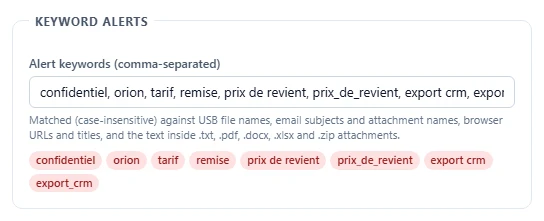
The tables below are starting points to adapt, not lists to apply as is. Each row gives a French keyword, what it catches and its false positive risk; a block then repeats the French list, ready to paste into the keyword field, followed by an English equivalent list with the same intent for UK and US documents. If your documents are in both languages, use both lists. Always add your own project, product and customer names: they produce the most precise alerts.
Core list (every organization)
| Keyword | What it catches | False positive risk |
|---|---|---|
confidenti | "Confidentiel", "confidentielle", "confidentialité", and the English "confidential" | High if your templates carry "Confidential" everywhere; ordinary non-disclosure agreements |
diffusion restreinte | The French protective marking ("restricted distribution"), or its use in companies | Low |
usage interne | "For internal use only" in its French variants, regardless of the apostrophe | High if it is the default label on templates |
ne pas diffuser | "Do not distribute" instructions on notes and presentations | Low |
secret des affaires | Documents marked as trade secrets | Medium: contracts and terms and conditions that mention the concept |
.pst | A copy of an entire Outlook mailbox archive, by file name | Low: backups made by IT |
.kdbx | A KeePass password database copied or sent | Low |
French list, ready to paste:
confidenti, diffusion restreinte, usage interne, ne pas diffuser,
secret des affaires, .pst, .kdbx
English equivalent:
confidenti, internal use, internal only, do not distribute, do not forward,
trade secret, .pst, .kdbx
For file upload sites, VigiDoc matches the address and title of visited pages. It flags the visit, not the uploaded file: it is a clue to cross-check with the rest of the computer's activity.
| Keyword | What it catches | False positive risk |
|---|---|---|
wetransfer, swisstransfer, grosfichiers, fromsmash, transfernow | Visits to large file transfer services (GrosFichiers is French, SwissTransfer is Swiss) | Medium: normal exchanges with customers or contractors |
mega.nz | Visits to MEGA cloud storage | Low |
dropbox, drive.google | Consumer cloud storage | High if the company or its customers use these services |
French list, ready to paste:
wetransfer, swisstransfer, grosfichiers, fromsmash, transfernow,
mega.nz, dropbox, drive.google
English equivalent (site names do not change with the language; drop the services nobody uses in your country):
wetransfer, fromsmash, transfernow, mega.nz, dropbox, drive.googleManufacturing and R&D
| Keyword | What it catches | False positive risk |
|---|---|---|
Project code name (e.g. projet atlas, projet_atlas) | Documents from a sensitive development | Low if the name is rare; high if it is common ("atlas" alone shows up in software and website names) |
prix de revient, coût de revient, cout de revient, prix_de_revient | Cost price calculations, the basis of your margins | Low |
gamme de fabrication | Routing sheets and production processes | Low |
nomenclature | Product bills of materials | Medium: customs and standards nomenclatures |
brevet | Draft patents, invention reports | Medium: published patents, technology watch |
.dwg, .step, .stp, .sldprt, .catpart | CAD files, by file extension (their content is not read) | Medium: normal exchanges with subcontractors |
Avoid in French: "plan" (planning, planche), "recette" (also means software acceptance testing), "formule" on its own. In English, avoid "plan" (planning, planet), "cad" (decade, cascade) and "formula" on its own.
French list, ready to paste:
prix de revient, coût de revient, cout de revient, prix_de_revient,
gamme de fabrication, nomenclature, brevet,
.dwg, .step, .stp, .sldprt, .catpart
English equivalent:
cost price, cost_price, unit cost, cost breakdown,
bill of materials, bill_of_materials, routing sheet, process sheet,
patent application, invention disclosure,
.dwg, .step, .stp, .sldprt, .catpart
Law firms
| Keyword | What it catches | False positive risk |
|---|---|---|
| Client or deal name | Documents from a sensitive matter | Low if the name is rare |
data room, dataroom, data-room, data_room | Data room indexes and extracts | Low |
due diligence | Acquisition due diligence reports | Low |
accord de confidentialit | Confidentiality agreements, with or without the accent | Medium: agreement templates |
transactionnel | Settlement agreements and protocols | Low in a law firm |
mandat ad hoc | Confidential pre-insolvency procedures under French law | Low |
Avoid in French: "nda" (agenda, mandat), "loi" (emploi, exploitation), "cession" on its own (concession, succession), "conciliation" on its own (labor court conciliation), and "confidentiel" on its own if the label appears on most of the firm's letters. In English, avoid "nda" (agenda, Monday, standard), "law" (flaw) and "confidential" on its own for the same reason.
French list, ready to paste:
data room, dataroom, data-room, data_room, due diligence,
accord de confidentialit, transactionnel, mandat ad hoc
English equivalent:
data room, dataroom, data-room, data_room, due diligence,
non-disclosure agreement, confidentiality agreement, settlement agreement,
without prejudice, legally privileged, attorney-client privilege
Accounting firms
| Keyword | What it catches | False positive risk |
|---|---|---|
fec20 | French statutory accounting entries files (FEC), whose name follows the pattern "SirenFECYYYYMMDD" | Low, but they are routinely sent to the client and the tax authorities |
liasse fiscale | Corporate tax return packages | Medium: normal exchanges with the client |
grand livre, grand-livre, grand_livre | General ledgers | Medium |
balance générale, balance generale | Trial balances | Medium |
bulletin de paie, bulletins de paie | Payslips produced by the payroll team | High if the firm runs payroll for its clients |
prévisionnel, previsionnel | Clients' financial forecasts and business plans | Medium |
Avoid in French: "fec" on its own (effectif, affectation), "paie" on its own (paiement), "visionnel" (which also finds "acompte provisionnel", a routine tax installment). In English, avoid "tax" on its own (syntax), "pay" on its own (payment) and "gl" (English).
French list, ready to paste:
fec20, liasse fiscale, grand livre, grand-livre, grand_livre,
balance générale, balance generale, bulletin de paie, bulletins de paie,
prévisionnel, previsionnel
English equivalent:
general ledger, general_ledger, trial balance, trial_balance, tax return,
payslip, pay slip, pay stub, financial forecast, cash flow forecast
Healthcare
| Keyword | What it catches | False positive risk |
|---|---|---|
liste des patients, liste patients, liste_patients | Patient lists and named extracts | Low |
dossier médical, dossier medical, dossier patient | Extracts from medical records | High in a facility, where they circulate every day: mostly useful on copies to USB drives |
sécurité sociale, securite sociale | Documents carrying a French social security number, by the field label | Medium: blank forms, standard letters |
carte vitale | Copies of French health insurance cards and billing documents | Medium |
identité nationale de santé, identite nationale de sante | Documents carrying the patient's French national health identifier (INS) | Medium |
opératoire, operatoire | Operative reports | Medium: operating room schedules |
Avoid in French: "patient" (patienter, patientèle), "ipp" (Philippe), "nir" (définir, fournir), "ins" (ainsi), "dpi" (300 dpi), and "ordonnance" (prescription) or "diagnostic", which are too common. In English, avoid "patient" on its own (outpatient, inpatient, patiently), "dob" (Adobe), "ssn" (classname) and "prescription". Alerts in this sector display health data: limit the number of people who review them.
French list, ready to paste:
liste des patients, liste patients, liste_patients,
dossier médical, dossier medical, dossier patient,
sécurité sociale, securite sociale, carte vitale,
identité nationale de santé, identite nationale de sante,
opératoire, operatoire
English equivalent:
patient list, patient_list, list of patients,
medical record, medical_record, patient record,
nhs number, national insurance number, social security number,
discharge summary, operative report, operation note,
protected health information
Finance and insurance
| Keyword | What it catches | False positive risk |
|---|---|---|
fr76 | French IBANs whose account number is all digits | High: every invoice carries the issuer's IBAN |
relevé de compte, releve de compte | Bank statements (add the plurals) | Medium |
portefeuille client | Client portfolios (the final plural is covered) | Low |
liste des assur | Lists of policyholders, with or without the accent | Low |
politiquement expos | Lists of politically exposed persons | Low |
information privil | Inside information (market abuse) | Low: internal procedures that mention the concept |
Avoid in French: "rib" (attribution, distribution, tribunal), "ppe" (développement), "iban" on its own (every invoice, and "Liban"), "sinistre" (claim) at an insurer, where it is everywhere. In English, avoid "iban" on its own, "pep" (pepper) and "claim" at an insurer. UK and US account numbers have no fixed prefix like "FR76", so rely on the labels next to them.
French list, ready to paste:
fr76, relevé de compte, relevés de compte, releve de compte, releves de compte,
portefeuille client, liste des assur, politiquement expos, information privil
English equivalent:
bank statement, account statement, sort code, routing number,
client portfolio, customer portfolio, policyholder list, list of policyholders,
politically exposed, inside information, material non-public, material nonpublic
"sort code" (UK) and "routing number" (US) carry the same risk as "fr76": they appear on every invoice that shows bank details.
Public sector
| Keyword | What it catches | False positive risk |
|---|---|---|
diffusion restreinte, ne pas diffuser | The IGI 1300 protective marking, and the common "do not distribute" phrase used instead | Low |
analyse des offres | Tender evaluation reports, sensitive until the contract is awarded | Low |
dpgf, offre financi | Bidders' financial offers (the DPGF is the French lump-sum price breakdown) | Low |
projet de décret, projet de decret | Draft decrees | Low |
note au ministre, note au cabinet | Briefing notes for the minister and the minister's office | Low |
embargo | Press releases and reports under embargo | Medium: news page titles |
Avoid in French: "dr" (droit, drive), "document de travail" (working document), found on too many documents. In English, avoid "draft" and "official" on their own (in the UK, most government information is classified OFFICIAL) and "cui" (biscuit, circuit).
French list, ready to paste:
diffusion restreinte, ne pas diffuser, analyse des offres, dpgf, offre financi,
projet de décret, projet de decret, note au ministre, note au cabinet, embargo
English equivalent:
official-sensitive, official sensitive, not for publication, do not distribute,
controlled unclassified, for official use only, tender evaluation, bid evaluation,
pricing schedule, draft regulation, ministerial submission, embargo
Defense and subcontractors
| Keyword | What it catches | False positive risk |
|---|---|---|
diffusion restreinte | Documents bearing the DR marking | Low |
spécial france, special france | The additional marking Spécial France (not releasable to foreign parties) | Low |
très secret, tres secret | The Très Secret (top secret) level | Low |
secret défense, secret defense, secret-défense, secret-defense, confidentiel défense, confidentiel defense, confidentiel-défense, confidentiel-defense | Former markings, used before July 1, 2021 | Low |
secret | The Secret level | High: "secret des affaires" (trade secret), "secret professionnel" (professional secrecy), "secretaire" without the accent; keep it if you receive classified documents, and accept the noise |
restreint, restricted | EU RESTRICTED (Restreint UE), NATO RESTRICTED, and the DR marking itself | Medium: "restricted access", English-language software |
double usage, itar | Goods and data subject to export controls (dual-use, US ITAR) | Medium: "itar" is short (guitare) |
Avoid in French: "dr" (droit, drive), "habilitation" on its own (it also means electrical work certification). In English, "secret" also finds "secretary", and "itar" finds "guitar"; avoid "clearance" on its own (clearance sale).
French list, ready to paste:
diffusion restreinte, spécial france, special france, très secret, tres secret,
secret défense, secret defense, secret-défense, secret-defense, confidentiel défense, confidentiel defense, confidentiel-défense, confidentiel-defense,
restreint, restricted, double usage, itar
English equivalent:
top secret, secret, official-sensitive, official sensitive, nato restricted, restricted,
controlled unclassified, export controlled, itar, dual-use, dual use
Warning
In France, digital classified information must be stored on an information system accredited for its level (IGI 1300, § 7.2.3), and Diffusion Restreinte information must not be sent over the internet or a system not accredited for that level, unless specific protective measures apply (IGI 1300, annex 1). Other countries have their own rules. If one of these keywords fires on a computer that is not accredited for that level, it is first a matter for your security officer: VigiDoc reports it, and the procedure set by your national rules applies.
Human resources (all sectors)
| Keyword | What it catches | False positive risk |
|---|---|---|
grille de salaire, grille_salaire, grille-salaire | Pay scales | Low |
masse salariale, masse_salariale | Payroll budgets and simulations | Low |
fiche de paie, bulletin de paie, bulletin de salaire (and plurals) | Payslips | Medium: monthly files sent to the payroll provider |
rupture conventionnelle, rupture_conventionnelle | Departure files (the French mutual termination agreement) | Low |
licenci | Dismissal, dismissed employees (licenciement, licencié) | Medium: letter templates, legal watch |
arrêt maladie, arret maladie | Sick leave notes (health data) | Medium |
_rh_ | Files named on the pattern "Dossier_RH_2027.xlsx" (RH is the French for HR) | Low, but does not see "RH.xlsx" |
Avoid in French: "rh" (Rhône, arrhes), "paie" on its own (paiement), "pse" (pseudo, éclipse), "plan de sauvegarde" (it also means IT backup plan), "salaire" on its own (job ads). In English, avoid "hr" (three, chrome, through), "pay" on its own (payment), "salary" on its own (job ads), "rif" (terrific, sheriff) and "redundancy" on its own (server redundancy).
French list, ready to paste:
grille de salaire, grille_salaire, grille-salaire, masse salariale, masse_salariale,
fiche de paie, fiches de paie, bulletin de paie, bulletins de paie,
bulletin de salaire, bulletins de salaire, rupture conventionnelle,
rupture_conventionnelle, licenci, arrêt maladie, arret maladie, _rh_
English equivalent:
pay scale, pay_scale, payscale, salary band, salary_band, salary review,
payroll, payslip, pay slip, pay stub, settlement agreement, severance,
redundancy consultation, redundancy list, termination letter,
sick note, fit note, medical leave, disciplinary, _hr_
Management, internal finance and sales (all sectors)
| Keyword | What it catches | False positive risk |
|---|---|---|
business plan, business_plan, businessplan | Business plans | Low |
prévisionnel, previsionnel, budget 2027 | Budgets and forecasts (update the year every year) | Medium |
comité de direction, comite de direction, codir | Executive committee minutes | Medium for "codir" (codirecteur, co-director) |
conseil d'administration, conseil d’administration | Board papers and minutes (both apostrophes) | Low |
projet de cession, data room | Planned sale of the business | Low |
fichier client, fichier_client, export client, export_client, base client | CRM exports and customer files, often .csv (caught by name) | Medium; "liste client" does not find "liste des clients" |
grille tarifaire, conditions tarifaires | Negotiated prices and price lists | Medium |
Avoid in French: "fusion" (merger; also finds diffusion), "marge" (page margins), "valorisation" (also used for waste recovery), "cession" on its own. In English, avoid "deal" (ideal), "lease" (release, please), "margin" (page margins) and "merger" on its own (news pages).
French list, ready to paste:
business plan, business_plan, businessplan, prévisionnel, previsionnel, budget 2027,
comité de direction, comite de direction, codir,
conseil d'administration, conseil d’administration, projet de cession, data room,
fichier client, fichier_client, export client, export_client, base client,
grille tarifaire, conditions tarifaires
English equivalent:
business plan, business_plan, businessplan, budget 2027, forecast 2027,
board minutes, board pack, board meeting, executive committee, data room,
customer list, customer_list, client list, client_list, crm export, crm_export,
price list, price_list, rate card
Reducing false positives
A single false positive is no big deal; a list that produces too many is, because the team stops looking. The causes come down to six cases.
| Cause | Example | Fix |
|---|---|---|
| Word too short | "hr" finds "three" and "chrome"; "nda" finds "agenda" and "Monday" (in French, "rh" finds "Rhône") | A longer phrase ("human resources") or a file name form ("_hr_") |
| Word hidden inside another | "lease" finds "release", "deal" finds "ideal", "pay" finds "payment" (in French, "fusion" finds "diffusion") | A full phrase: "lease agreement", "pay slip" |
| Label printed everywhere | "Internal use" in the footer of every template | Remove the label and keep the higher levels |
| Everyday word in your business | "patient" in a clinic, "claim" at an insurer | Target exports and lists: "patient list" |
| Word found in web addresses | A common project name ("atlas") in site names; a short word in address identifiers | Full project name ("project atlas"), a longer keyword |
| Legitimate, regular flow | Payslips sent every month to the payroll provider | Keep the keyword and note the flow as routine, so you recognize it quickly |
A good keyword ticks four boxes:
- it is rare in day-to-day work;
- it is specific to the documents you do not want to see leave;
- it is long enough not to hide inside other words;
- it appears where VigiDoc looks: file name, email subject, readable document text, page address or title.
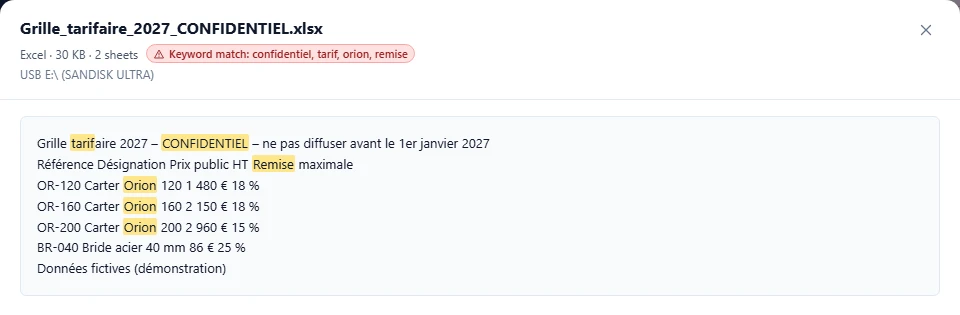
To judge an alert, open the preview of the captured document: if the highlighted term is a label or a title, the alert is real; if it sits in the middle of another word or in unrelated text, the keyword needs fixing.
Tuning the list during a 30-day trial
A list can only be judged on your real files and flows. The VigiDoc trial lasts 30 days: enough to go from a broad list to a tuned one, in four weeks.
- Before day one: prepare the list and inform employees. Gather the labels, project names and file names collected above, and prepare a few test files (see below). Check your local employment and privacy law (GDPR in the EU) before monitoring starts. In France, for example, employees must be told beforehand about any system that collects information about them (article L1222-4 of the Labor Code), and monitoring must stay proportionate to its purpose (article L1121-1). For any legal question, consult your lawyer.
- Week 1: broad list and observation. Enter the core list, your sector list and your proper names. Do not remove anything yet: for each alert, note the keyword, the channel (USB drive, Outlook, webmail, browser) and whether it was useful. Run the test files through a test computer.
- Week 2: remove the noise. For each keyword, compare useful alerts with noise. Replace terms that are too short with a longer form, remove a label that appears on all your templates, and note routine flows (payroll provider, external accountant) so you recognize them at a glance.
- Week 3: add variants. Go through the names of files actually copied and attached: add the forms without accents, with underscores or hyphens, and in-house abbreviations. Add the code names of current projects.
- Week 4: freeze the list and the routine. Keep a dated version of the list, with the reason each term is there. Decide who reviews alerts and how often, and plan a review for every new sensitive project, every high-risk departure and every change of document templates.
| Keyword | What the alerts showed | Decision |
|---|---|---|
hr | Unrelated pages and files ("three", "chrome") | Removed, replaced by _hr_ and human resources |
internal use | Every document created from the letter template | Removed; confidenti and strictly confidential kept |
pay scale | No alerts, even though the file circulates | Added payscale, found in the file's real name |
wetransfer | Visits linked to routine exchanges with a customer | Kept, flow noted as routine |
Test files show you, on your own setup, what each keyword really sees. Prepare them with keywords from your list:
- a .docx whose label ("Strictly confidential") appears only in the header or footer;
- the same document, with the label in the body text;
- a scanned PDF with no selectable text;
- a .csv export named like your CRM exports;
- a .zip archive containing the .docx, then the same archive protected by a password;
- a file whose name uses an underscore ("Pay_Scale_2027.xlsx") while the list only contains "pay scale" (for French documents, an unaccented name such as "Previsionnel_2027.xlsx" while the list only contains "prévisionnel").
Copy them to a USB drive from a test computer, email them to yourself as attachments from Outlook, then check in the Dashboard which ones come up and for which keyword. For USB drives, our guide How to tell if an employee copied files to a USB drive also shows what Windows keeps, or not, without a dedicated tool.
Test your keywords with VigiDoc
In VigiDoc, the list is entered in the Dashboard settings and applies to the four monitored channels: files copied to USB drives, emails sent from Outlook with their attachments, attachments added in Gmail and Outlook on the web, and pages visited in Chrome, Edge or Firefox. Each match comes up as an alert, without blocking anything, and the preview of the captured document highlights the term found: enough to judge an alert and adjust the list quickly.
The free 30-day trial starts when the server is installed, on your own network, with no license to request: the right time to put the lists on this page to the test against your real files.
Frequently asked questions
Which keywords should you put in a DLP tool?
Start with the classification labels already on your documents ("Confidential", "Internal use only", or in French "Confidentiel", "Diffusion restreinte", "Usage interne"), then add the names of your strategic projects and customers and the names of your sensitive files (pay scale, cost price, customer export). Avoid short words and the everyday terms of your business, which trigger alerts everywhere. A starting list is then tuned over a few weeks, based on real alerts.
What do classification levels C1, C2, C3 and C4 mean?
They are internal codes, specific to each organization: for example C0 for public information, C1 for internal use, then increasing levels up to confidential or secret. No standard mandates these codes: ISO/IEC 27002 asks you to define a classification scheme and label information accordingly. For a DLP tool, only the label actually written on the documents matters.
Is "Diffusion Restreinte" a classification level?
No. Under France's General Interministerial Instruction no. 1300 of August 9, 2021, Diffusion Restreinte (restricted distribution) is a protective marking, not a classification level. Since July 1, 2021, the French Defense Code provides for only two classification levels: Secret and Très Secret (top secret).
Is VigiDoc case-sensitive and accent-sensitive?
Case is ignored: "confidential" finds "CONFIDENTIAL". Accents do matter: "résumé" does not find "resume", and the French "prévisionnel" does not find "previsionnel". Add the unaccented form of every accented keyword, because file names and text in capitals often drop accents.
Why does a keyword trigger too many false positives?
In VigiDoc, a keyword is searched as a piece of text, even in the middle of another word: "hr" finds "three" and "plan" finds "planning". The other usual causes are a label printed on every company template and an everyday term of your business. Replace those terms with longer phrases, proper names or labels reserved for sensitive documents.
Can VigiDoc detect a credit card or social security number?
No. VigiDoc does not recognize patterns: it searches for keywords, without regular expressions. You find the documents concerned through the label next to the number ("social security number", "IBAN") or through a fixed fragment, such as "FR76", which starts French IBANs whose account number is all digits. Other DLP tools, such as Microsoft Purview, recognize this kind of number by pattern.
Sources
- French Defense Code, article R2311-2, version in force since July 1, 2021 (Secret and Très Secret levels, in French).
- Decree no. 2019-1271 of December 2, 2019, articles 10 and 11 (entry into force and equivalence of former levels, in French).
- SGDSN, General Interministerial Instruction no. 1300 on the protection of national defense secrets (instruction générale interministérielle n° 1300 sur la protection du secret de la défense nationale), August 9, 2021: § 1.3.1, § 1.3.2, § 7.1.1.3, § 7.2.3 and annex 1; approved by the order of August 9, 2021.
- ANSSI, interministerial instruction no. 901/SGDSN/ANSSI of January 28, 2015, on the protection of sensitive information systems (in French).
- ISO/IEC 27002:2022, information security controls, 3rd edition (controls 5.12 and 5.13).
- Microsoft Learn, Learn about the default sensitivity labels and policies to protect your data, accessed October 14, 2026.
- French Tax Procedures Code, article A47 A-1, IX (name of the accounting entries file), and BOFiP, BOI-CF-IOR-60-40-20, version of June 7, 2017 (in French).
- French Labor Code, article L1222-4 and article L1121-1 (in French).